Lessons in connection: CopyCon 2025
CopyCon 2025 was a sharp reminder of why effective copy that really sings (and resonates) starts with how we adapt as writers.
Scroll Down ↓
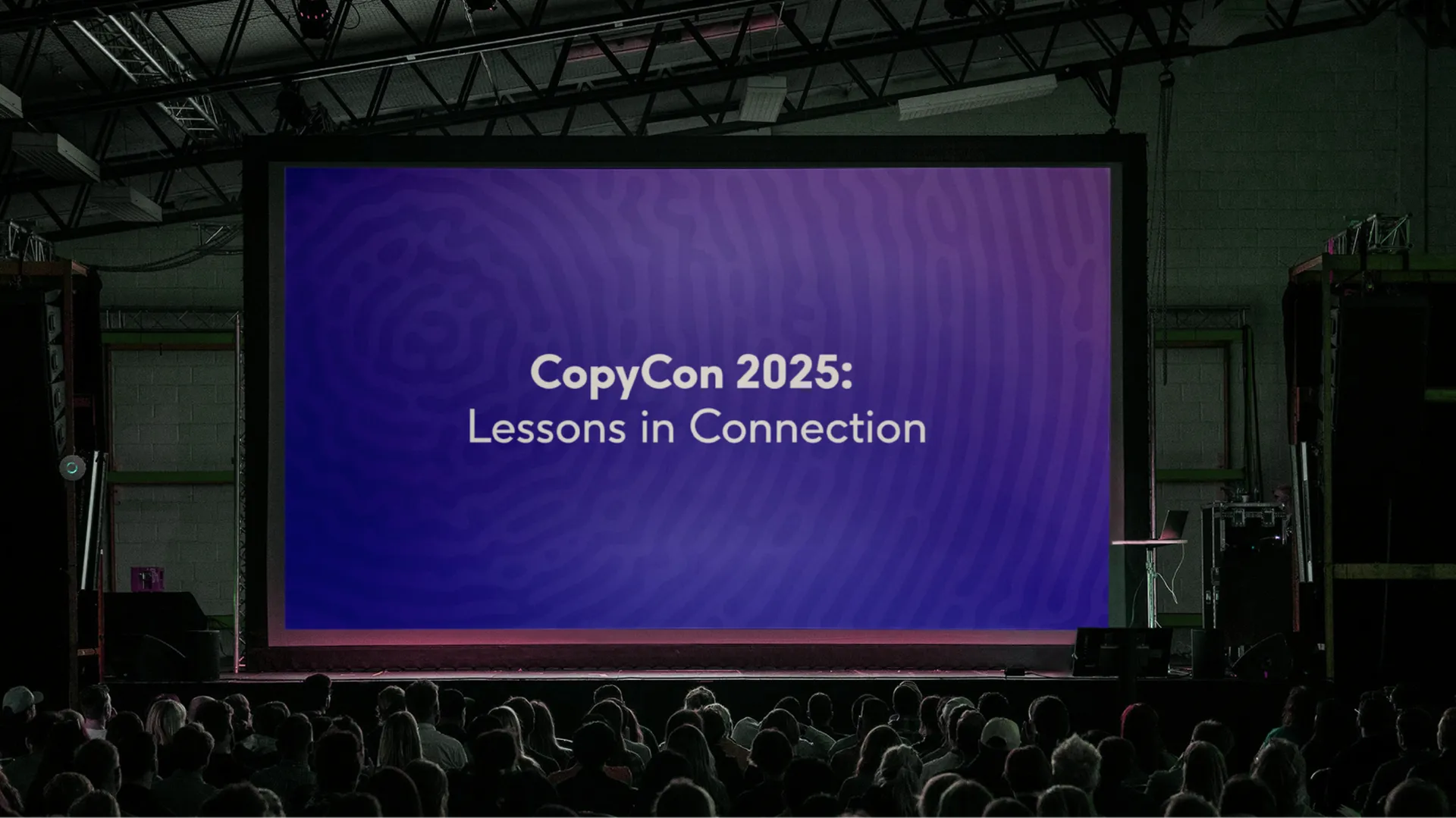
Our copy team came away with fresh angles on things we face every day in agency life: strategic alignment, messy briefs, AI’s growing presence, and the fight against creative drift. It was a practical look back at the past and a huge nod to the future of how we breed connection with copy.
So, here’s a look behind the curtain at the conversations shaping our industry right now. It’s the things us copywriters compare notes on and return to when we’re sharpening our craft for real-world commercial impact.
From Lucy Grogan, Senior Copywriter:
1. Strategy and tactics must work together
This idea hit home because it’s something copywriters often feel but don’t always say out loud. Strategy gives our work direction, but tactics make things move. One without the other is either a pretty deck gathering dust or a scatter of disconnected ideas. But when both are in play, our copy has power. At a digital marketing agency, that means staying curious, asking better questions before you start writing, challenging briefs when they’re too thin, or making sure every flow serves the bigger picture. Whenever the two line up, words start driving outcomes.
2. Uncovering what’s hidden in the shadows of a brief
I liked the analogy of treating change like an expedition. It’s a reminder that every project hides more than the brief reveals, you just have to walk the terrain to uncover it. That means surfacing the things clients don’t always say but that shape how people respond to what we write, so the work feels different from the start. At an agency, this way of thinking encourages us to dig deeper before landing on a creative direction. It’s pure curiosity combined with patience and tapping into our collective experience to get to the heart of the matter and reflect the real story, rather than what’s on the surface.
3. Humanity before everything
For copywriters, Large Language Models (LLMs) are going to expose the average work that shouldn’t have made it out the door in the first place. That’s a good thing, it simply raises the bar. As writers, our expertise needs to fold into how we use these new tools, because although a good writer can competently steer an LLM, a great one can see the gaps it’ll never close. That’s where our value sits as creatives, in shaping the meaning and the tone. It will always be this difference that clients expect to make their voices sing and get them sitting pretty above their competition.
4. Find nuggets of creative brilliance with AI
When it comes to using LLMs to their full potential in our copywriting process, the best course of action is to embrace it as a studio partner, lest we fall behind the curve. Because AI has all the makings of a lighthouse: illuminating the way to creative expression through to giving us the luxury of maximum efficiency. One way we can do this is by prompting it to go deeper into the research and into the creative heart of the brief itself to find the “so what’s,” the why’s, the “hidden gems.” For example, it’s as easy as one simple shift: get the LLM to ask you questions, instead of the other way around. This keeps the copy team in the driver’s seat, allowing our deep need for the creative human touch steer the start of the writing process into something meaningful.
5. Don’t let boredom stop you from taking pride in your work
Another great piece of validation gleaned from a fair few talks: creative dullness isn’t fixed by waiting for Inspiration Cupid to strike. Your brain is a muscle, it needs exercise. Haikus, micro-headlines, word games, story drills: all of it builds our creative reflexes that find “the angles” (as our journalist friends might say) when everyone else lands on the obvious. That matters in our agency life, where briefs can get repetitive. The product might not change all that much, but our thinking can. We owe it to our clients never to become stale, so keeping our curiosity sharp is what turns seemingly “everyday work” into career-making projects. Because why not?
From Caoimhe Donnelly, Junior Copywriter:
1. Clear briefs = great work
Trying to explain the importance of a clear brief can feel like banging your head against a wall. It’s not that we need our hands held, but too often there’s an assumption that the creative will pick up the slack. We do our best to fill in the gaps, but it’s only after version one that we’re told it doesn’t fit the objective. And so the feedback loop begins. For us, a clear brief that nails the direction, tone, audience and competitors gives creatives the context to tailor work to the exact goal. It shortens those loops, reduces wasted time, and keeps everyone moving in the same direction. Clarity doesn’t kill creativity; it gives it space to breathe. Because when the brief is clear, the work sings.
2. Feedback isn’t criticism, it’s critical!
When we receive feedback, it can feel like a slight on our own vision. But really, feedback is one of the most important parts of any copy process. The more we learn and adapt, the stronger we become as writers and the sharper the work gets. To improve at receiving feedback, we also need thoughtful feedback. Sometimes when it lands, we’re not sure what’s essential and what’s just a passing thought. So for the reviewer, think of it this way: ask yourself, “Is this a hill I’m ready to die on?” If it is, say so. And if it’s just a suggestion or passing thought, make that clear too. Clearer feedback leads to better communication, and in my opinion, that’s what leads to great copy.
3. Reigniting a copywriter’s creative spark
Why did we become copywriters? For most of us, it started with a love of being creative, turning ideas into stories, poems or pictures. But as we get older and focus on honing our craft, we lean into process and strategy. Writing becomes rigid and rule-following. We learn how to make words work hard. But somewhere in that pursuit of precision, the spark can fade. Reigniting that spark isn’t about chasing inspiration, it’s about reconnecting with curiosity. Reading something that moves you. Writing something that isn’t for a client. Giving yourself time to play with words again, to write with that same childlike freedom that got you started in the first place. And what’s the point if we’re already good at copywriting? Because play reminds us to take risks, to do something different. We can all be good at writing, but the copy that truly stands out is the kind that challenges the norm and has fun with language.
4. A real brand voice shows up everywhere
Something that really struck me is how often we forget about the mundane sides of brand voice. It’s easy to pour energy into making it shine on social posts, a new website or a punchy blog. It feels loud and proud, and it should become part of the organisation, right? But what we fail to remember, what we can’t afford to forget, is that for a brand voice to stick, it has to be everywhere. Not just on the creative side. From footers to T&Cs, job descriptions, and even “out of order” signs on bathroom stalls, a company should strive to express its voice in every corner. If it doesn’t, it’s not really a voice. It’s just words filling space.
5. Creativity is connection, not perfection
Perfection can be a trap. We chase it because we want to make something everyone loves. But look at any great piece of art, some will love it, some will hate it. What matters is that it connects. It’s not about grand impressions anymore; it’s about making connections that last. But breaking the cycle of perfectionism isn’t easy. To do it, we have to let go of our pride and lean into uncertainty. Uncertain whether people will love it, unsure whether it will even work. That uncertainty is what keeps us learning. It’s what pushes us to keep improving, to keep creating. When you start to believe your work is perfect, you stop growing. And in our world of copy, marketing and design, there’s always room to grow. Without uncertainty, there’s no progress. And without connection, there’s no point.
Our copy team came away with fresh angles on things we face every day in agency life: strategic alignment, messy briefs, AI’s growing presence, and the fight against creative drift. It was a practical look back at the past and a huge nod to the future of how we breed connection with copy.
So, here’s a look behind the curtain at the conversations shaping our industry right now. It’s the things us copywriters compare notes on and return to when we’re sharpening our craft for real-world commercial impact.
From Lucy Grogan, Senior Copywriter:
1. Strategy and tactics must work together
This idea hit home because it’s something copywriters often feel but don’t always say out loud. Strategy gives our work direction, but tactics make things move. One without the other is either a pretty deck gathering dust or a scatter of disconnected ideas. But when both are in play, our copy has power. At a digital marketing agency, that means staying curious, asking better questions before you start writing, challenging briefs when they’re too thin, or making sure every flow serves the bigger picture. Whenever the two line up, words start driving outcomes.
2. Uncovering what’s hidden in the shadows of a brief
I liked the analogy of treating change like an expedition. It’s a reminder that every project hides more than the brief reveals, you just have to walk the terrain to uncover it. That means surfacing the things clients don’t always say but that shape how people respond to what we write, so the work feels different from the start. At an agency, this way of thinking encourages us to dig deeper before landing on a creative direction. It’s pure curiosity combined with patience and tapping into our collective experience to get to the heart of the matter and reflect the real story, rather than what’s on the surface.
3. Humanity before everything
For copywriters, Large Language Models (LLMs) are going to expose the average work that shouldn’t have made it out the door in the first place. That’s a good thing, it simply raises the bar. As writers, our expertise needs to fold into how we use these new tools, because although a good writer can competently steer an LLM, a great one can see the gaps it’ll never close. That’s where our value sits as creatives, in shaping the meaning and the tone. It will always be this difference that clients expect to make their voices sing and get them sitting pretty above their competition.
4. Find nuggets of creative brilliance with AI
When it comes to using LLMs to their full potential in our copywriting process, the best course of action is to embrace it as a studio partner, lest we fall behind the curve. Because AI has all the makings of a lighthouse: illuminating the way to creative expression through to giving us the luxury of maximum efficiency. One way we can do this is by prompting it to go deeper into the research and into the creative heart of the brief itself to find the “so what’s,” the why’s, the “hidden gems.” For example, it’s as easy as one simple shift: get the LLM to ask you questions, instead of the other way around. This keeps the copy team in the driver’s seat, allowing our deep need for the creative human touch steer the start of the writing process into something meaningful.
5. Don’t let boredom stop you from taking pride in your work
Another great piece of validation gleaned from a fair few talks: creative dullness isn’t fixed by waiting for Inspiration Cupid to strike. Your brain is a muscle, it needs exercise. Haikus, micro-headlines, word games, story drills: all of it builds our creative reflexes that find “the angles” (as our journalist friends might say) when everyone else lands on the obvious. That matters in our agency life, where briefs can get repetitive. The product might not change all that much, but our thinking can. We owe it to our clients never to become stale, so keeping our curiosity sharp is what turns seemingly “everyday work” into career-making projects. Because why not?
From Caoimhe Donnelly, Junior Copywriter:
1. Clear briefs = great work
Trying to explain the importance of a clear brief can feel like banging your head against a wall. It’s not that we need our hands held, but too often there’s an assumption that the creative will pick up the slack. We do our best to fill in the gaps, but it’s only after version one that we’re told it doesn’t fit the objective. And so the feedback loop begins. For us, a clear brief that nails the direction, tone, audience and competitors gives creatives the context to tailor work to the exact goal. It shortens those loops, reduces wasted time, and keeps everyone moving in the same direction. Clarity doesn’t kill creativity; it gives it space to breathe. Because when the brief is clear, the work sings.
2. Feedback isn’t criticism, it’s critical!
When we receive feedback, it can feel like a slight on our own vision. But really, feedback is one of the most important parts of any copy process. The more we learn and adapt, the stronger we become as writers and the sharper the work gets. To improve at receiving feedback, we also need thoughtful feedback. Sometimes when it lands, we’re not sure what’s essential and what’s just a passing thought. So for the reviewer, think of it this way: ask yourself, “Is this a hill I’m ready to die on?” If it is, say so. And if it’s just a suggestion or passing thought, make that clear too. Clearer feedback leads to better communication, and in my opinion, that’s what leads to great copy.
3. Reigniting a copywriter’s creative spark
Why did we become copywriters? For most of us, it started with a love of being creative, turning ideas into stories, poems or pictures. But as we get older and focus on honing our craft, we lean into process and strategy. Writing becomes rigid and rule-following. We learn how to make words work hard. But somewhere in that pursuit of precision, the spark can fade. Reigniting that spark isn’t about chasing inspiration, it’s about reconnecting with curiosity. Reading something that moves you. Writing something that isn’t for a client. Giving yourself time to play with words again, to write with that same childlike freedom that got you started in the first place. And what’s the point if we’re already good at copywriting? Because play reminds us to take risks, to do something different. We can all be good at writing, but the copy that truly stands out is the kind that challenges the norm and has fun with language.
4. A real brand voice shows up everywhere
Something that really struck me is how often we forget about the mundane sides of brand voice. It’s easy to pour energy into making it shine on social posts, a new website or a punchy blog. It feels loud and proud, and it should become part of the organisation, right? But what we fail to remember, what we can’t afford to forget, is that for a brand voice to stick, it has to be everywhere. Not just on the creative side. From footers to T&Cs, job descriptions, and even “out of order” signs on bathroom stalls, a company should strive to express its voice in every corner. If it doesn’t, it’s not really a voice. It’s just words filling space.
5. Creativity is connection, not perfection
Perfection can be a trap. We chase it because we want to make something everyone loves. But look at any great piece of art, some will love it, some will hate it. What matters is that it connects. It’s not about grand impressions anymore; it’s about making connections that last. But breaking the cycle of perfectionism isn’t easy. To do it, we have to let go of our pride and lean into uncertainty. Uncertain whether people will love it, unsure whether it will even work. That uncertainty is what keeps us learning. It’s what pushes us to keep improving, to keep creating. When you start to believe your work is perfect, you stop growing. And in our world of copy, marketing and design, there’s always room to grow. Without uncertainty, there’s no progress. And without connection, there’s no point.