The Brand Strategy Framework Every Small Business Needs
Scroll Down ↓
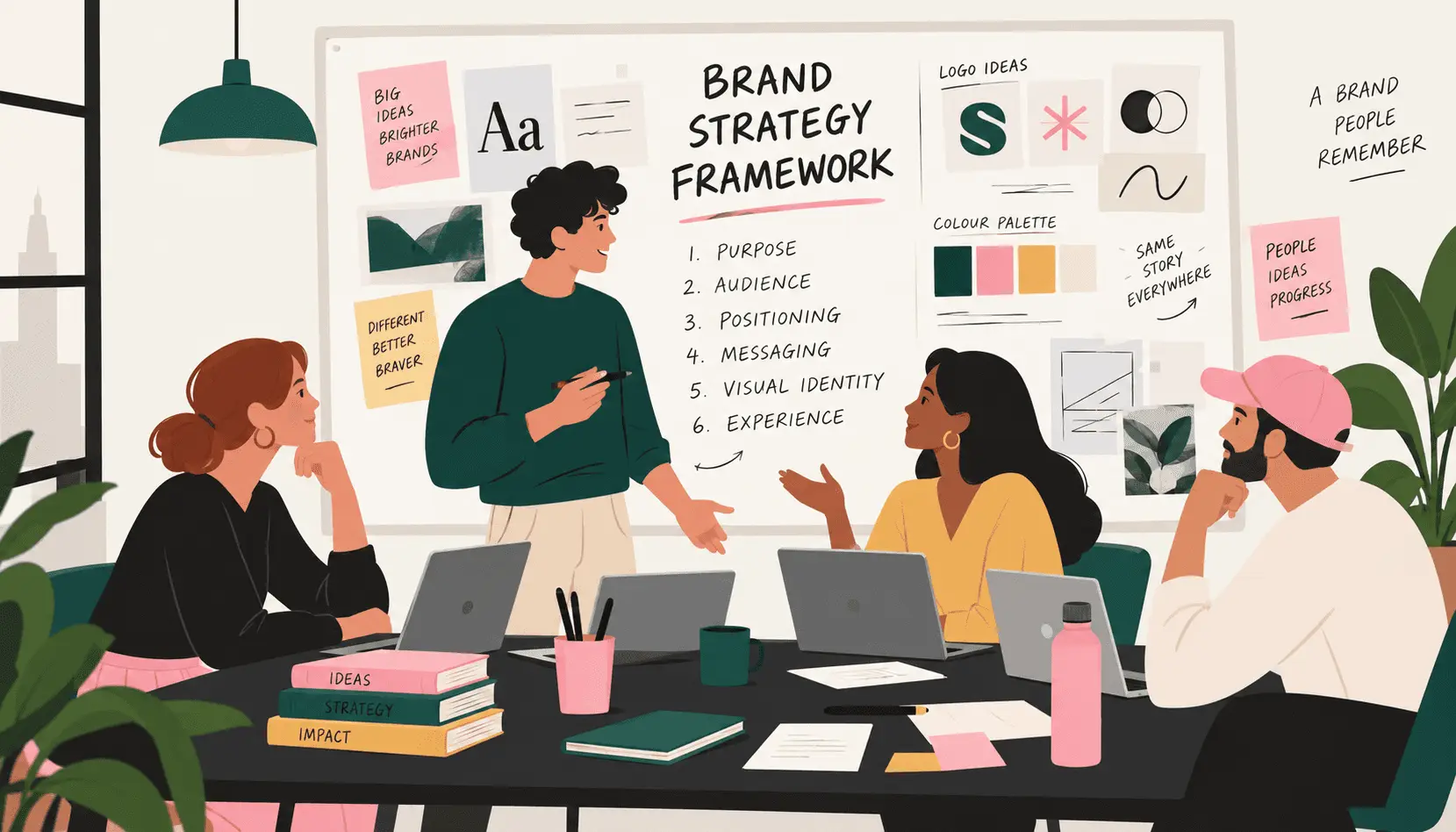
A strong brand goes beyond a logo or colour palette. It’s about knowing exactly how you want to be seen, who you’re speaking to and what you want people to remember.
A brand strategy framework helps you make those choices and stick to them as your business grows.
In this guide, we’ll break down the essentials of brand strategy, walk you through building your own, and share practical steps and examples you can put to work.
What Is a Brand Strategy Framework?

A brand strategy framework is a structured guide that defines your brand’s identity, core values, target audience, how you want to be seen in the market and how you will achieve those goals over time.
It helps a business make consistent decisions about:
How you differentiate from others in your industry
Who you’re trying to reach and what matters to them
What you can communicate and how you can communicate it
How your brand shows up across different channels and touchpoints
Where your brand is heading as your business grows.
Simply put, a brand strategy framework is the foundation of your business. It keeps your messaging, visuals, website and campaigns all working towards the same goals, instead of pulling in different directions. When you use real audience insights to shape your strategy, you’re making decisions based on facts, not assumptions.
The framework isn’t the same as a brand strategy. Instead, it gives you a structure for asking the right questions, challenges assumptions and making deliberate decisions about where your brand should go.
There is no single brand strategy template that works for every business. The right approach depends on your stage of growth, industry and what you’re trying to achieve. Whether that’s launching a new product, supporting a higher price point or bringing two companies together following a merger.
Are Brand Strategy and a Brand Strategy Framework the Same Thing?
No. A brand strategy is the direction and decisions that shape your brand, while a brand strategy framework is the structure you use to develop those decisions.
The framework helps you define your purpose, understand your audience, establish your positioning, develop your messaging and shape how your brand looks and feels.
Put simply: your brand strategy is the outcome. Your brand strategy framework is how you build it.
What’s the Difference Between Brand Strategy, Brand Identity and Brand Guidelines?
Brand strategy explains the thinking and direction behind your brand, brand identity turns that strategy into something people can instantly recognise, and brand guidelines provide rules to keep it consistent.
Brand strategy | Brand identity | Brand guidelines | |
|---|---|---|---|
What is it? | The direction behind your brand and the decisions that shape how it should be positioned. | The visual and verbal elements people use to recognise and experience your brand. | A set of rules for how your brand identity should be used and applied. |
What does it involve? | Purpose, audience, positioning, values, messaging and long-term direction. | Logo, colour, typography, imagery, messaging and tone of voice. | Logo usage, colour codes, typography rules, imagery, guidance and tone of voice guide. |
What does it answer? | Who we are, who we are for and why should people choose us? | How should our brand look, sound and feel? | How do we keep our brand consistent whenever it appears? |
When does it happen? | First. It creates the strategic foundation for the brand. | After the strategic direction is defined. | Once the identity has been developed and needs to be applied consistently. |
Order matters. If you jump into design before you know what your brand needs to say, you might end up with a great-looking website that doesn’t connect. If your audience can’t see what you offer or why it matters, even the best visuals won’t drive results.

When we rebranded Annex, we brought its new name, visual identity and tone of voice together around a clear brand direction. That meant every touchpoint, from the colour palette and copy to product videos, worked together to create a strong, consistent identity.
The Core Pillars of a Brand Strategy Framework
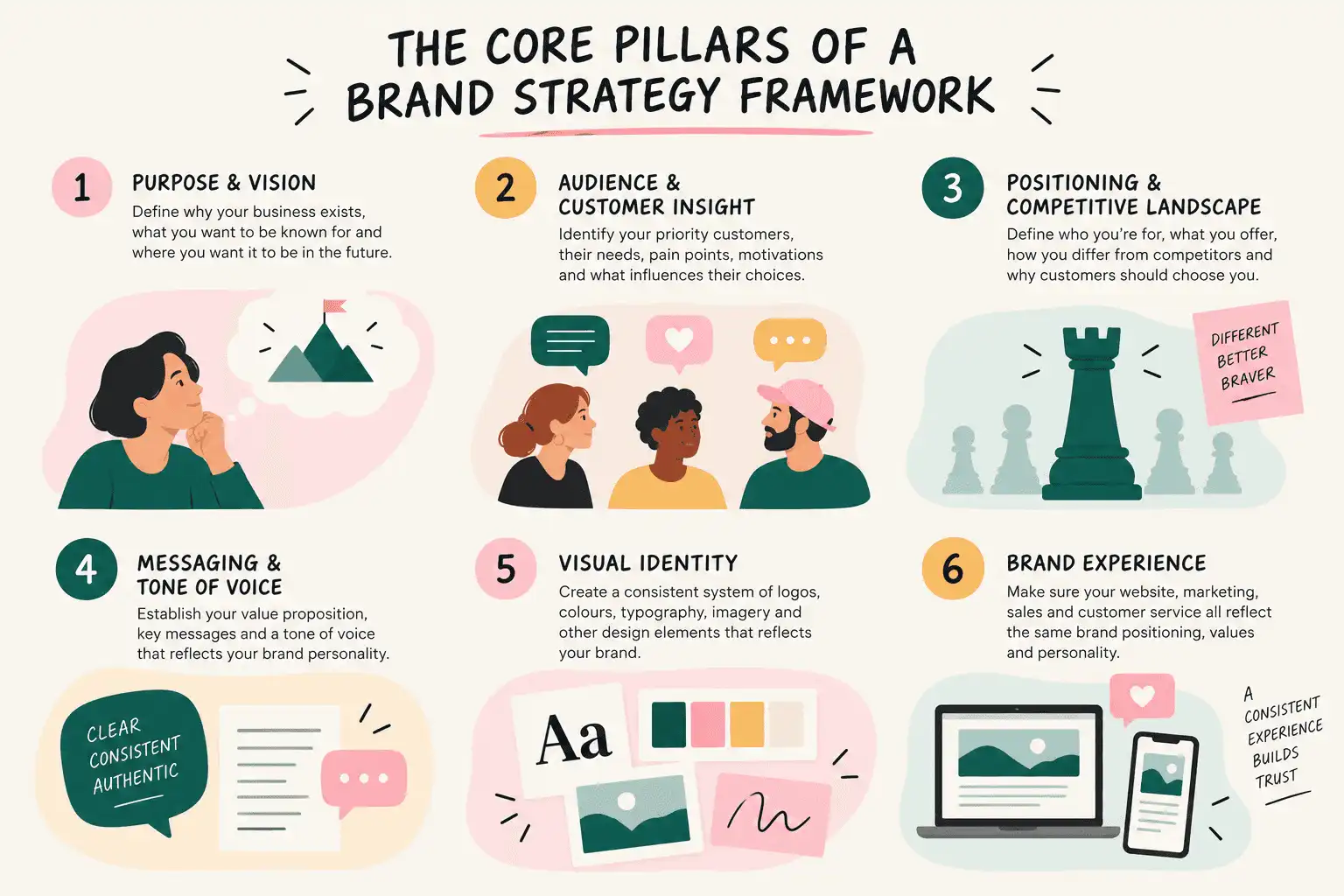
The six core pillars of a brand strategy framework are:
1. Purpose and vision
2. Audience and customer insight
3. Positioning and competitive landscape
4. Messaging and tone of voice
5. Visual identity
6. Brand experience
Together, these pillars cover why your brand exists, who it’s for, how you’re positioned, what you need to say and how it all comes to life across your visuals and customer touchpoints.
Working through each area gives you a solid foundation for every brand decision; from shaping your value proposition and messaging to designing your website, planning campaigns and building a consistent customer experience.
1. Purpose and Vision
Brand purpose defines why your business exists and the impact it wants to have, while brand vision defines where you want the business to go. Together, they give your brand a long-term direction and a reference point for making strategic decisions.
Your purpose and vision should guide real decisions. If you’re considering a new service, entering a new market or changing how you communicate, check if it supports the brand you want to build.
What you stand for should show up in what you do. Your messaging, customer experience and business decisions all need to back up the values you share. That’s how you build an authentic brand.
Start by asking:
Why does our business exist beyond generating revenue?
What impact do we want to have?
What do we want to be known for?
Where do we want the business and brand to be in three to five years?
2. Audience and Customer Insight
Audience and customer insight means knowing who you need to reach, what matters to them and what drives their decisions. This understanding shapes your positioning, messaging, customer experience and how you show your value.
Go beyond basic demographics like age or location. Interviews, surveys, reviews, website behaviour and sales conversations can reveal what motivates your customers, what frustrates them and the words they use to describe their needs.
Bringing these insights together helps you make smarter decisions. When you use data to guide your choices on positioning, messaging and customer experience, you can back up every move.
Start by asking:
Who are our priority customers?
What are they trying to achieve?
What problems or frustrations do they experience?
What influences their decision when choosing between brands?
What language do they use to describe their needs?
Which assumptions about our audience haven't we validated?
3. Positioning and Competitive Landscape
Brand positioning is how you want people to see your brand compared to others. Your competitive landscape shows where you can stand out. Together, they help you get clear on who you’re for, what makes you different and why someone should pick you.
Competitor research isn’t about copying others. Look at how they position themselves, who they target and what they promise. When brands start to blend together, those gaps are your chance to stand out.
Your positioning should answer:
Who are we for?
What market or category do we compete in?
What do we offer that matters to our audience?
What makes us meaningfully different?
Why should someone choose us over an alternative?
Differentiation only works if it’s believable. If you claim to be innovative, sustainable or customer-focused, make sure you can show what makes it true.
Your positioning may also need to evolve as the business grows. When Designfit expanded into the KSA market, its brand needed to appeal to larger international clients and reflect the scale of projects it was competing for. Its positioning, visual identity and digital presence were developed to support that next stage of growth.

4. Messaging and Tone of Voice
Brand messaging is what you need to say. Tone of voice is how you say it. Together, they turn your positioning into clear, consistent language your audience will recognise.
Your messaging should establish your value proposition, key benefits, differentiators and proof points. From there, your tone of voice gives those messages personality, helping your brand communicate consistently without every piece of copy sounding the same.
The words you choose shape how clearly people understand your offer and what they do next. Good brand copy needs to do more than just sound nice.
Your tone should flex for the audience, channel and situation. A sales proposal won’t sound like an Instagram post, but both should still feel like you. When you know how different audiences respond to language and tone, you can adapt without losing your brand’s voice.
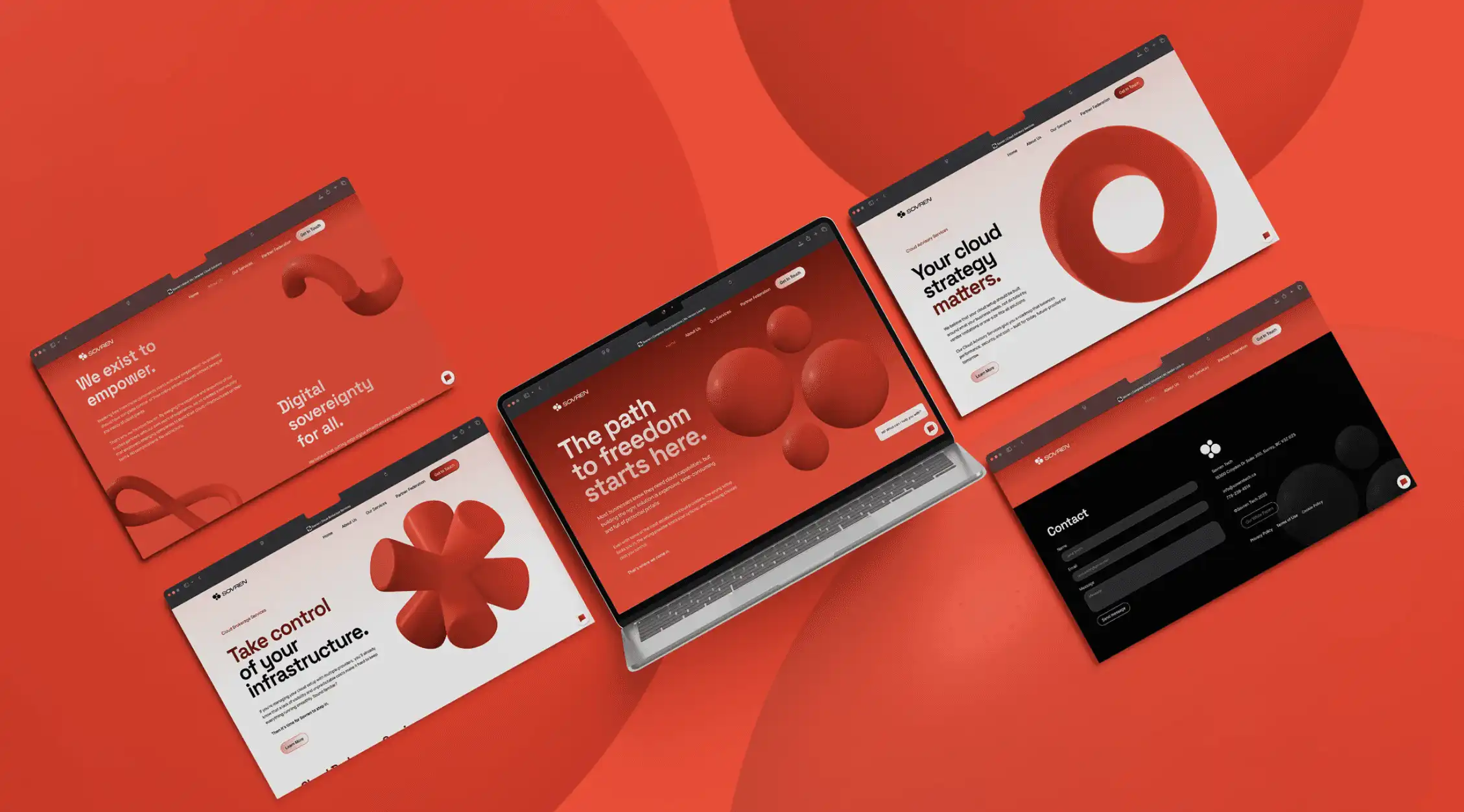
For Sovren, this meant communicating complex cloud services without relying on unnecessary technical jargon. Its messaging retained the expertise expected within the sector while making the brand more approachable and easier to understand.
5. Visual Identity
Visual identity is how your brand strategy is expressed through design. It includes elements such as your logo, colour palette, typography, imagery, illustration and iconography, which work together to make your brand recognisable.
These choices should reflect the positioning and personality you've already established. A visual identity isn't simply about what looks good. It should communicate something about who you are and create a distinctive look that makes sense for your audience and market.
Your logo is one part of that system, not the brand itself. Distinctiveness, simplicity and adaptability all contribute to what makes a good logo.
As the identity is applied across websites, social media, campaigns and other touchpoints, maintaining consistency across your brand identity helps people recognise it wherever they encounter you.
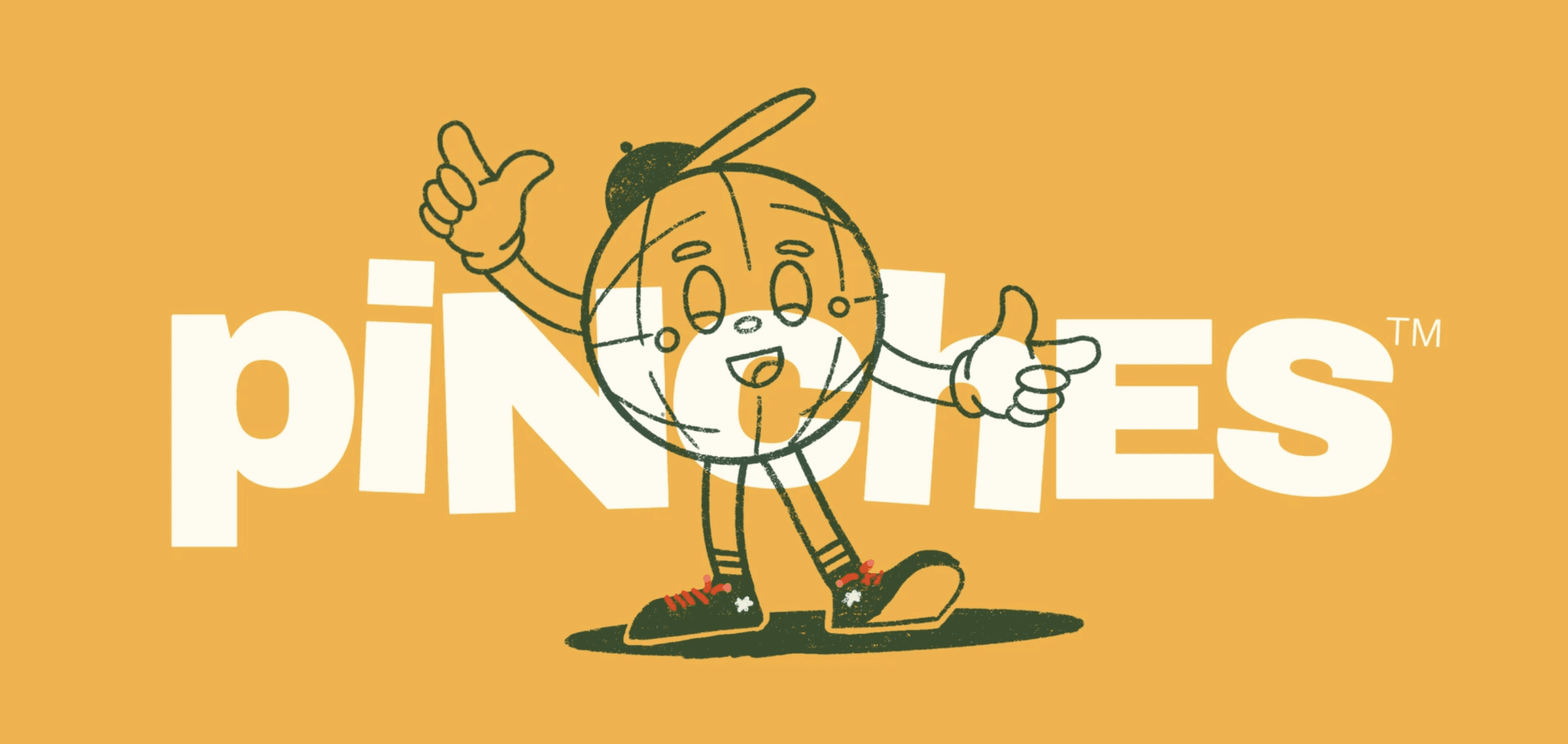
For Pinches, earthy colours, playful illustration and mixed-case lettering helped create a warmer, more approachable identity that could work across packaging, digital, events and community initiatives.
6. Brand Experience
Brand experience is the impression people get from every interaction with your business. It brings all the pillars of your brand strategy together, across search, social media, your website, sales, customer service, products and every bit of communication.
The goal isn’t to make every interaction identical. It’s to make sure each one feels consistent, with the same positioning, messaging, personality and values.
Your website is often one of the most important brand touchpoints. Design and copy shape the experience, but so do navigation, instructions, forms, buttons and other seemingly small interactions. Good UX writing can make digital experiences clearer and easier to use while still reinforcing the brand's personality.
Think about the whole customer journey. If your website feels straightforward and approachable but your sales process is complicated and full of corporate language, there’s a disconnect. Even the best visuals can’t make up for a frustrating experience.
When all six pillars work together, your brand strategy framework becomes a practical reference point for decisions across marketing, design, customer experience and future growth.
How to Build Your Brand Development Strategy
A brand development strategy is the process of researching, defining and applying the decisions that shape your brand. A practical process involves six stages:
· Audit your current brand
· Research your audience and market
· Define your strategic direction
· Build your messaging
· Develop your visual identity
· Implement the strategy
Following these steps in order means your decisions about messaging, design and marketing are based on evidence and a clear direction.
Step 1: Audit Your Current Brand
A brand audit evaluates how your brand currently looks, communicates and performs across its main customer touchpoints.
Review your website, social channels, marketing materials, sales documents and customer communications. The aim isn't to find reasons to replace everything, but to identify what still supports the business and where the brand has become inconsistent or outdated.
Separate your findings into three categories:
Keep | Improve | Reconsider |
|---|---|---|
Elements that still represent the business and resonate with customers | Areas that are working but need greater clarity or consistency | Elements that no longer reflect your audience, positioning or direction |
Include both visual and verbal elements. For example, a recognisable visual identity might still be valuable even if the messaging around it needs to change.
Step 2: Research Your Audience and Market
Brand research helps you understand your customers, competitors and wider market before deciding how the brand should develop.
Use customer feedback, reviews, sales conversations, website behaviour and market research to identify:
Recurring customer needs and frustrations
Reasons people choose or reject your business
Language customers use to describe their needs
Competitor positioning and claims
Gaps or opportunities within the market
Assumptions about your audience that still need validating
Focus on insights that can influence a decision, not on collecting data for its own sake. By the end of this stage, you should have evidence to support who you're targeting, what matters to them and where your brand has an opportunity to compete.
Step 3: Define Your Strategic Direction
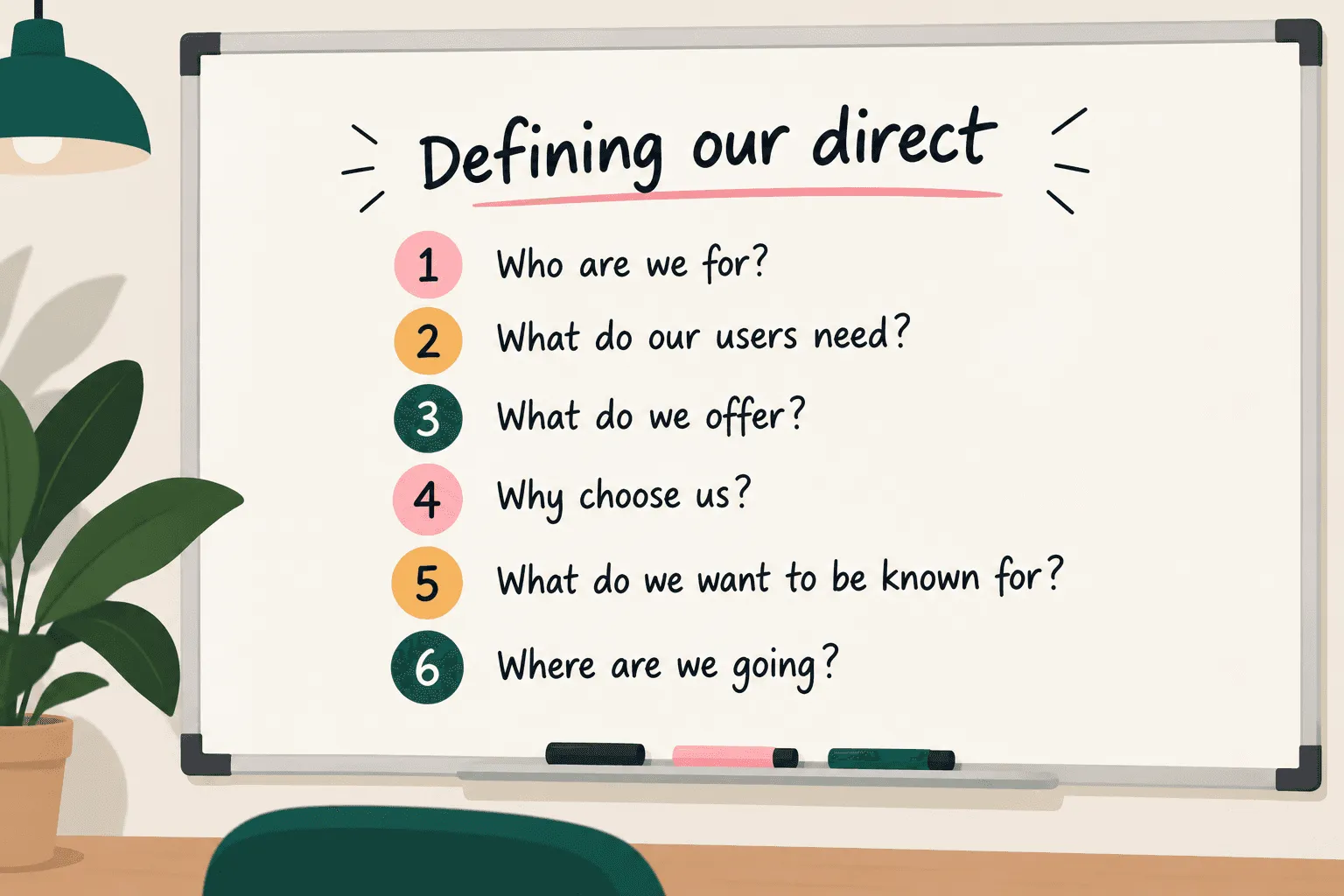
Next, turn your research into a clear brand positioning and strategic direction.
You don’t need to go through every pillar again. Just write down the decisions your research has helped you make:
Decision | Your Answer |
|---|---|
Who are we for? | Your target audience |
What do they need? | Their main problem, motivation or opportunity |
What do we offer? | Your core proposition |
Why choose us? | Your meaningful point of difference |
What do we want to be known for? | Your desired market position |
Where are we going? | Your long-term brand direction |
Your answers should be specific enough to guide future decisions. If they could fit any competitor, your positioning needs more work.
Step 4: Build Your Messaging
Once your positioning is clear, turn it into a brand messaging hierarchy that establishes what customers need to understand about your business and in what order.
A simple structure is:
Core proposition → Customer benefit → Differentiators → Proof → Supporting messages
This gives your website, sales materials, campaigns and other communications a shared foundation, without forcing every channel to use the same copy.
You can then develop your tone of voice and adapt the messaging to suit different audiences, channels and stages of the customer journey.
Step 5: Translate the Strategy into a Visual Identity
Your strategy acts as the creative brief for your visual identity.
Logo, typography, colour, imagery, illustration and other design elements can then be developed around what the brand needs to communicate rather than what's currently fashionable.
For example:
Strategic decision | Possible design implication |
|---|---|
Premium positioning | Greater restraint, considered typography and high-quality imagery |
Approachable personality | Warmer imagery and more informal visual elements |
Technical expertise | Clear information hierarchy and a structured design system |
Challenger positioning | More distinctive choices that break category conventions |
These aren’t hard rules. The point is to make sure there’s a strategic reason behind your creative choices.
Once your identity is set, create brand guidelines that show how to use your visual and verbal elements. This makes it easier for everyone- employees, designers, copywriters, marketers and partners- to keep your brand consistent.
Step 6: Roll Out, Measure and Grow Your Brand
Brand implementation is the process of applying your strategy across the customer touchpoints that matter most.
You don’t need to change everything at once. Focus on the places that matter most for how customers find, evaluate and experience your business, like:
Website
Sales and pitch materials
Social profiles
Email communications
Advertising and campaigns
Customer communications
Then decide how you’ll measure if the strategy is working. The right metrics depend on your goal. If you’re repositioning to attract bigger clients, focus on lead quality and deal value. If you’re expanding into a new market, look at awareness, traffic, enquiries and customer acquisition.
Plan to regularly review customer feedback, website behaviour, conversions, sales conversations and overall business performance. The goal is to keep your brand in sync with your business as your audience, market and goals change.
Brand Development Strategy: The Process at a Glance
Stage | What you're doing | What you should have at the end |
|---|---|---|
| Assessing your current brand | Keep, improve and reconsider list |
| Understanding your audience, competitors and market | Evidence and key insights |
| Establishing positioning and strategic direction | Clear brand direction |
| Structuring what and how you communicate | Messaging hierarchy and tone of voice |
| Translating strategy into design | Visual identity and brand guidelines |
| Applying, measuring and reviewing the strategy | Consistent rollout and measurement plan |
The order matters. Research should inform your positioning, positioning should inform your messaging and messaging and strategy should guide your visual identity. That creates a brand development strategy in which each decision has a clear reason behind it.
Brand Strategy Examples
A strong brand strategy gives your business a clear direction, shaping everything from messaging and identity to the customer experience. Here are three brands that show how different strategic decisions work in practice.
Patagonia: Purpose
Patagonia has built its brand around environmental responsibility, with its purpose to “save our home planet” influencing more than its marketing. In 2022, the company changed its ownership structure so money not reinvested in the business could help fight the environmental crisis.
Its approach to environmental and social responsibility shows how a clear purpose can influence decisions across the wider business, rather than simply becoming a line in a brand strategy document.
Liquid Death: Differentiation

Liquid Death entered a crowded water market by deliberately breaking many of the category's conventions.
Instead of focusing on familiar ideas around purity and wellness, its brand positioning uses irreverent humour, distinctive packaging and an identity influenced by entertainment, beer and heavy metal.
It’s a great example of how knowing your competitive landscape can help you position a familiar product in a fresh way.
Airbnb: Brand Idea
Airbnb built its brand around something broader than booking accommodation: belonging.
Its idea of creating a world where people can “belong anywhere” gave the business a central concept that could extend across its messaging, identity, hosts, guests and wider customer experience.
Airbnb’s focus on belonging and community shows how a simple brand idea can connect every part of the experience under one clear direction.
Common Brand Strategy and Planning Mistakes
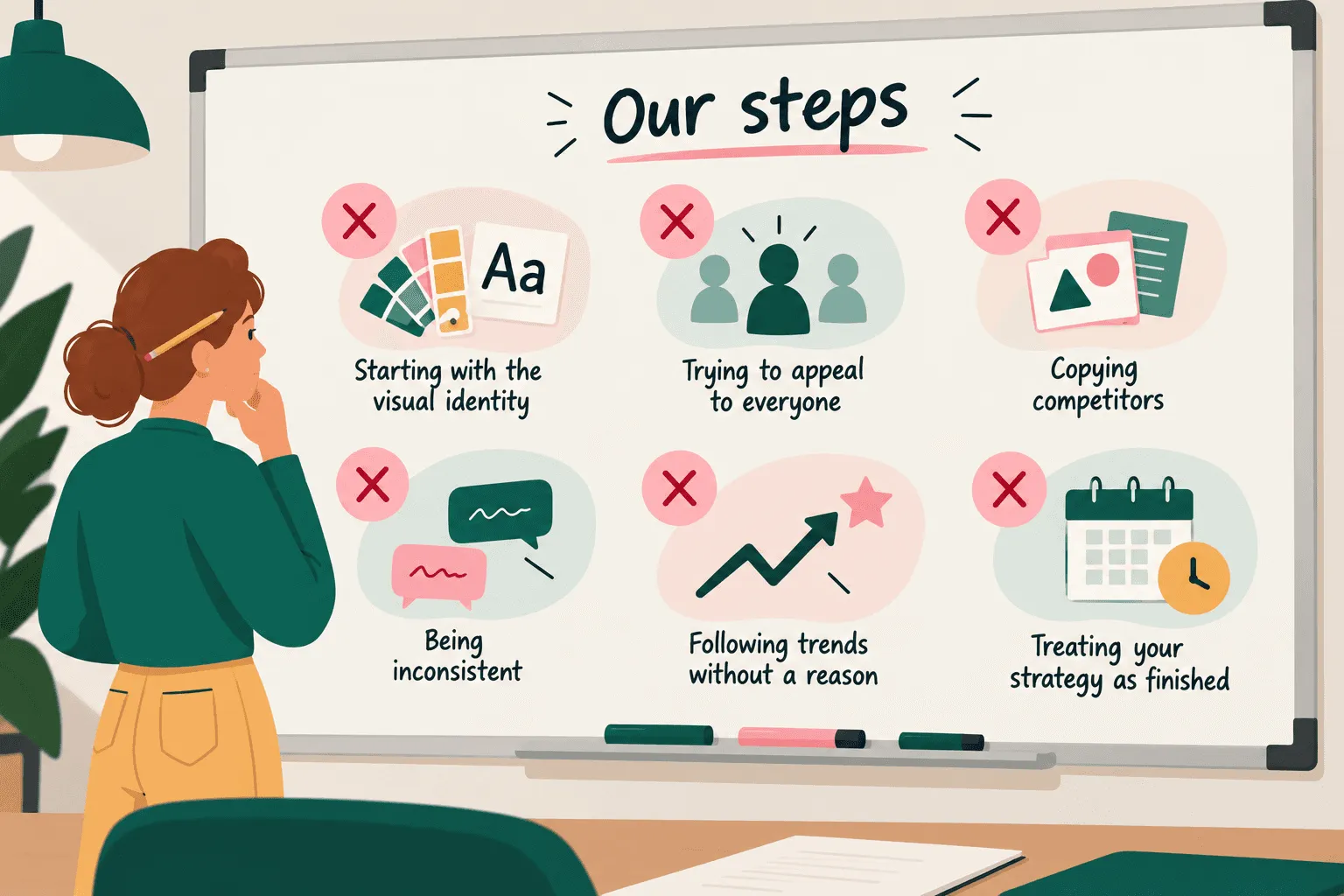
Even the best brand plan can lose direction if it’s not applied properly. Here are some common mistakes:
Starting with the visual identity: Define your audience, positioning and messaging before jumping into logos, colours and design.
Trying to appeal to everyone: A clear audience makes it easier to develop relevant positioning and messaging.
Copying competitors: Use competitor research to find gaps and opportunities, not a template to follow.
Being inconsistent: Your brand can adapt across channels without losing the elements that make it recognisable.
Following trends without a reason: Not every new design, platform or marketing trend will make sense for your brand or audience.
Treating your strategy as finished: Review your strategy as your business, market and customers evolve.
Why Small Businesses Need a Brand Strategy
Small business branding doesn’t need to be as complex as a big corporate strategy, but the basics still matter. When budgets and resources are tight, a clear direction helps you decide where to invest and what to prioritise.
A brand strategy can help small businesses:
Make limited budgets work harder by giving websites, campaigns and creative work a clear direction.
Compete more effectively by identifying where you can stand apart rather than trying to match larger competitors.
Keep everyone aligned as employees, freelancers and external partners begin communicating on behalf of the business.
Plan for growth by creating a foundation that can adapt as you introduce new services, audiences or markets.
Your framework doesn’t need to be complicated. It just needs to give you enough clarity to make consistent decisions as your business grows.
How Studio East Can Help
A brand strategy framework gives you something to come back to as your business grows. Whether you’re building a new website, launching a campaign or entering a new market, it keeps your decisions connected to the same audience, positioning and goals.
But building the strategy is just the start. You also need to turn that thinking into a brand people can understand, recognise and remember.
At Studio East, we bring brand strategy, messaging, visual identity and digital together. Whether you’re building a brand from scratch or repositioning an existing one, we’ll help you define where it needs to go and turn that direction into something real.
Ready to build a stronger brand? Book a call with us.
Frequently Asked Questions
What is a brand strategy framework?
What are the key elements of a brand strategy?
What are the core pillars of a brand strategy?
Is there a standard brand strategy framework?
What are the key steps to implement a brand strategy framework?
How long does it take to build a brand strategy?
How much does brand strategy cost for a small business?
How often should you review your brand strategy?
A strong brand goes beyond a logo or colour palette. It’s about knowing exactly how you want to be seen, who you’re speaking to and what you want people to remember.
A brand strategy framework helps you make those choices and stick to them as your business grows.
In this guide, we’ll break down the essentials of brand strategy, walk you through building your own, and share practical steps and examples you can put to work.
What Is a Brand Strategy Framework?
A brand strategy framework is a structured guide that defines your brand’s identity, core values, target audience, how you want to be seen in the market and how you will achieve those goals over time.
It helps a business make consistent decisions about:
How you differentiate from others in your industry
Who you’re trying to reach and what matters to them
What you can communicate and how you can communicate it
How your brand shows up across different channels and touchpoints
Where your brand is heading as your business grows.
Simply put, a brand strategy framework is the foundation of your business. It keeps your messaging, visuals, website and campaigns all working towards the same goals, instead of pulling in different directions. When you use real audience insights to shape your strategy, you’re making decisions based on facts, not assumptions.
The framework isn’t the same as a brand strategy. Instead, it gives you a structure for asking the right questions, challenges assumptions and making deliberate decisions about where your brand should go.
There is no single brand strategy template that works for every business. The right approach depends on your stage of growth, industry and what you’re trying to achieve. Whether that’s launching a new product, supporting a higher price point or bringing two companies together following a merger.
Are Brand Strategy and a Brand Strategy Framework the Same Thing?
No. A brand strategy is the direction and decisions that shape your brand, while a brand strategy framework is the structure you use to develop those decisions.
The framework helps you define your purpose, understand your audience, establish your positioning, develop your messaging and shape how your brand looks and feels.
Put simply: your brand strategy is the outcome. Your brand strategy framework is how you build it.
What’s the Difference Between Brand Strategy, Brand Identity and Brand Guidelines?
Brand strategy explains the thinking and direction behind your brand, brand identity turns that strategy into something people can instantly recognise, and brand guidelines provide rules to keep it consistent.
Brand strategy | Brand identity | Brand guidelines | |
|---|---|---|---|
What is it? | The direction behind your brand and the decisions that shape how it should be positioned. | The visual and verbal elements people use to recognise and experience your brand. | A set of rules for how your brand identity should be used and applied. |
What does it involve? | Purpose, audience, positioning, values, messaging and long-term direction. | Logo, colour, typography, imagery, messaging and tone of voice. | Logo usage, colour codes, typography rules, imagery, guidance and tone of voice guide. |
What does it answer? | Who we are, who we are for and why should people choose us? | How should our brand look, sound and feel? | How do we keep our brand consistent whenever it appears? |
When does it happen? | First. It creates the strategic foundation for the brand. | After the strategic direction is defined. | Once the identity has been developed and needs to be applied consistently. |
Order matters. If you jump into design before you know what your brand needs to say, you might end up with a great-looking website that doesn’t connect. If your audience can’t see what you offer or why it matters, even the best visuals won’t drive results.
When we rebranded Annex, we brought its new name, visual identity and tone of voice together around a clear brand direction. That meant every touchpoint, from the colour palette and copy to product videos, worked together to create a strong, consistent identity.
The Core Pillars of a Brand Strategy Framework
The six core pillars of a brand strategy framework are:
1. Purpose and vision
2. Audience and customer insight
3. Positioning and competitive landscape
4. Messaging and tone of voice
5. Visual identity
6. Brand experience
Together, these pillars cover why your brand exists, who it’s for, how you’re positioned, what you need to say and how it all comes to life across your visuals and customer touchpoints.
Working through each area gives you a solid foundation for every brand decision; from shaping your value proposition and messaging to designing your website, planning campaigns and building a consistent customer experience.
1. Purpose and Vision
Brand purpose defines why your business exists and the impact it wants to have, while brand vision defines where you want the business to go. Together, they give your brand a long-term direction and a reference point for making strategic decisions.
Your purpose and vision should guide real decisions. If you’re considering a new service, entering a new market or changing how you communicate, check if it supports the brand you want to build.
What you stand for should show up in what you do. Your messaging, customer experience and business decisions all need to back up the values you share. That’s how you build an authentic brand.
Start by asking:
Why does our business exist beyond generating revenue?
What impact do we want to have?
What do we want to be known for?
Where do we want the business and brand to be in three to five years?
2. Audience and Customer Insight
Audience and customer insight means knowing who you need to reach, what matters to them and what drives their decisions. This understanding shapes your positioning, messaging, customer experience and how you show your value.
Go beyond basic demographics like age or location. Interviews, surveys, reviews, website behaviour and sales conversations can reveal what motivates your customers, what frustrates them and the words they use to describe their needs.
Bringing these insights together helps you make smarter decisions. When you use data to guide your choices on positioning, messaging and customer experience, you can back up every move.
Start by asking:
Who are our priority customers?
What are they trying to achieve?
What problems or frustrations do they experience?
What influences their decision when choosing between brands?
What language do they use to describe their needs?
Which assumptions about our audience haven't we validated?
3. Positioning and Competitive Landscape
Brand positioning is how you want people to see your brand compared to others. Your competitive landscape shows where you can stand out. Together, they help you get clear on who you’re for, what makes you different and why someone should pick you.
Competitor research isn’t about copying others. Look at how they position themselves, who they target and what they promise. When brands start to blend together, those gaps are your chance to stand out.
Your positioning should answer:
Who are we for?
What market or category do we compete in?
What do we offer that matters to our audience?
What makes us meaningfully different?
Why should someone choose us over an alternative?
Differentiation only works if it’s believable. If you claim to be innovative, sustainable or customer-focused, make sure you can show what makes it true.
Your positioning may also need to evolve as the business grows. When Designfit expanded into the KSA market, its brand needed to appeal to larger international clients and reflect the scale of projects it was competing for. Its positioning, visual identity and digital presence were developed to support that next stage of growth.
4. Messaging and Tone of Voice
Brand messaging is what you need to say. Tone of voice is how you say it. Together, they turn your positioning into clear, consistent language your audience will recognise.
Your messaging should establish your value proposition, key benefits, differentiators and proof points. From there, your tone of voice gives those messages personality, helping your brand communicate consistently without every piece of copy sounding the same.
The words you choose shape how clearly people understand your offer and what they do next. Good brand copy needs to do more than just sound nice.
Your tone should flex for the audience, channel and situation. A sales proposal won’t sound like an Instagram post, but both should still feel like you. When you know how different audiences respond to language and tone, you can adapt without losing your brand’s voice.
For Sovren, this meant communicating complex cloud services without relying on unnecessary technical jargon. Its messaging retained the expertise expected within the sector while making the brand more approachable and easier to understand.
5. Visual Identity
Visual identity is how your brand strategy is expressed through design. It includes elements such as your logo, colour palette, typography, imagery, illustration and iconography, which work together to make your brand recognisable.
These choices should reflect the positioning and personality you've already established. A visual identity isn't simply about what looks good. It should communicate something about who you are and create a distinctive look that makes sense for your audience and market.
Your logo is one part of that system, not the brand itself. Distinctiveness, simplicity and adaptability all contribute to what makes a good logo.
As the identity is applied across websites, social media, campaigns and other touchpoints, maintaining consistency across your brand identity helps people recognise it wherever they encounter you.
For Pinches, earthy colours, playful illustration and mixed-case lettering helped create a warmer, more approachable identity that could work across packaging, digital, events and community initiatives.
6. Brand Experience
Brand experience is the impression people get from every interaction with your business. It brings all the pillars of your brand strategy together, across search, social media, your website, sales, customer service, products and every bit of communication.
The goal isn’t to make every interaction identical. It’s to make sure each one feels consistent, with the same positioning, messaging, personality and values.
Your website is often one of the most important brand touchpoints. Design and copy shape the experience, but so do navigation, instructions, forms, buttons and other seemingly small interactions. Good UX writing can make digital experiences clearer and easier to use while still reinforcing the brand's personality.
Think about the whole customer journey. If your website feels straightforward and approachable but your sales process is complicated and full of corporate language, there’s a disconnect. Even the best visuals can’t make up for a frustrating experience.
When all six pillars work together, your brand strategy framework becomes a practical reference point for decisions across marketing, design, customer experience and future growth.
How to Build Your Brand Development Strategy
A brand development strategy is the process of researching, defining and applying the decisions that shape your brand. A practical process involves six stages:
· Audit your current brand
· Research your audience and market
· Define your strategic direction
· Build your messaging
· Develop your visual identity
· Implement the strategy
Following these steps in order means your decisions about messaging, design and marketing are based on evidence and a clear direction.
Step 1: Audit Your Current Brand
A brand audit evaluates how your brand currently looks, communicates and performs across its main customer touchpoints.
Review your website, social channels, marketing materials, sales documents and customer communications. The aim isn't to find reasons to replace everything, but to identify what still supports the business and where the brand has become inconsistent or outdated.
Separate your findings into three categories:
Keep | Improve | Reconsider |
|---|---|---|
Elements that still represent the business and resonate with customers | Areas that are working but need greater clarity or consistency | Elements that no longer reflect your audience, positioning or direction |
Include both visual and verbal elements. For example, a recognisable visual identity might still be valuable even if the messaging around it needs to change.
Step 2: Research Your Audience and Market
Brand research helps you understand your customers, competitors and wider market before deciding how the brand should develop.
Use customer feedback, reviews, sales conversations, website behaviour and market research to identify:
Recurring customer needs and frustrations
Reasons people choose or reject your business
Language customers use to describe their needs
Competitor positioning and claims
Gaps or opportunities within the market
Assumptions about your audience that still need validating
Focus on insights that can influence a decision, not on collecting data for its own sake. By the end of this stage, you should have evidence to support who you're targeting, what matters to them and where your brand has an opportunity to compete.
Step 3: Define Your Strategic Direction
Next, turn your research into a clear brand positioning and strategic direction.
You don’t need to go through every pillar again. Just write down the decisions your research has helped you make:
Decision | Your Answer |
|---|---|
Who are we for? | Your target audience |
What do they need? | Their main problem, motivation or opportunity |
What do we offer? | Your core proposition |
Why choose us? | Your meaningful point of difference |
What do we want to be known for? | Your desired market position |
Where are we going? | Your long-term brand direction |
Your answers should be specific enough to guide future decisions. If they could fit any competitor, your positioning needs more work.
Step 4: Build Your Messaging
Once your positioning is clear, turn it into a brand messaging hierarchy that establishes what customers need to understand about your business and in what order.
A simple structure is:
Core proposition → Customer benefit → Differentiators → Proof → Supporting messages
This gives your website, sales materials, campaigns and other communications a shared foundation, without forcing every channel to use the same copy.
You can then develop your tone of voice and adapt the messaging to suit different audiences, channels and stages of the customer journey.
Step 5: Translate the Strategy into a Visual Identity
Your strategy acts as the creative brief for your visual identity.
Logo, typography, colour, imagery, illustration and other design elements can then be developed around what the brand needs to communicate rather than what's currently fashionable.
For example:
Strategic decision | Possible design implication |
|---|---|
Premium positioning | Greater restraint, considered typography and high-quality imagery |
Approachable personality | Warmer imagery and more informal visual elements |
Technical expertise | Clear information hierarchy and a structured design system |
Challenger positioning | More distinctive choices that break category conventions |
These aren’t hard rules. The point is to make sure there’s a strategic reason behind your creative choices.
Once your identity is set, create brand guidelines that show how to use your visual and verbal elements. This makes it easier for everyone- employees, designers, copywriters, marketers and partners- to keep your brand consistent.
Step 6: Roll Out, Measure and Grow Your Brand
Brand implementation is the process of applying your strategy across the customer touchpoints that matter most.
You don’t need to change everything at once. Focus on the places that matter most for how customers find, evaluate and experience your business, like:
Website
Sales and pitch materials
Social profiles
Email communications
Advertising and campaigns
Customer communications
Then decide how you’ll measure if the strategy is working. The right metrics depend on your goal. If you’re repositioning to attract bigger clients, focus on lead quality and deal value. If you’re expanding into a new market, look at awareness, traffic, enquiries and customer acquisition.
Plan to regularly review customer feedback, website behaviour, conversions, sales conversations and overall business performance. The goal is to keep your brand in sync with your business as your audience, market and goals change.
Brand Development Strategy: The Process at a Glance
Stage | What you're doing | What you should have at the end |
|---|---|---|
| Assessing your current brand | Keep, improve and reconsider list |
| Understanding your audience, competitors and market | Evidence and key insights |
| Establishing positioning and strategic direction | Clear brand direction |
| Structuring what and how you communicate | Messaging hierarchy and tone of voice |
| Translating strategy into design | Visual identity and brand guidelines |
| Applying, measuring and reviewing the strategy | Consistent rollout and measurement plan |
The order matters. Research should inform your positioning, positioning should inform your messaging and messaging and strategy should guide your visual identity. That creates a brand development strategy in which each decision has a clear reason behind it.
Brand Strategy Examples
A strong brand strategy gives your business a clear direction, shaping everything from messaging and identity to the customer experience. Here are three brands that show how different strategic decisions work in practice.
Patagonia: Purpose
Patagonia has built its brand around environmental responsibility, with its purpose to “save our home planet” influencing more than its marketing. In 2022, the company changed its ownership structure so money not reinvested in the business could help fight the environmental crisis.
Its approach to environmental and social responsibility shows how a clear purpose can influence decisions across the wider business, rather than simply becoming a line in a brand strategy document.
Liquid Death: Differentiation
Liquid Death entered a crowded water market by deliberately breaking many of the category's conventions.
Instead of focusing on familiar ideas around purity and wellness, its brand positioning uses irreverent humour, distinctive packaging and an identity influenced by entertainment, beer and heavy metal.
It’s a great example of how knowing your competitive landscape can help you position a familiar product in a fresh way.
Airbnb: Brand Idea
Airbnb built its brand around something broader than booking accommodation: belonging.
Its idea of creating a world where people can “belong anywhere” gave the business a central concept that could extend across its messaging, identity, hosts, guests and wider customer experience.
Airbnb’s focus on belonging and community shows how a simple brand idea can connect every part of the experience under one clear direction.
Common Brand Strategy and Planning Mistakes
Even the best brand plan can lose direction if it’s not applied properly. Here are some common mistakes:
Starting with the visual identity: Define your audience, positioning and messaging before jumping into logos, colours and design.
Trying to appeal to everyone: A clear audience makes it easier to develop relevant positioning and messaging.
Copying competitors: Use competitor research to find gaps and opportunities, not a template to follow.
Being inconsistent: Your brand can adapt across channels without losing the elements that make it recognisable.
Following trends without a reason: Not every new design, platform or marketing trend will make sense for your brand or audience.
Treating your strategy as finished: Review your strategy as your business, market and customers evolve.
Why Small Businesses Need a Brand Strategy
Small business branding doesn’t need to be as complex as a big corporate strategy, but the basics still matter. When budgets and resources are tight, a clear direction helps you decide where to invest and what to prioritise.
A brand strategy can help small businesses:
Make limited budgets work harder by giving websites, campaigns and creative work a clear direction.
Compete more effectively by identifying where you can stand apart rather than trying to match larger competitors.
Keep everyone aligned as employees, freelancers and external partners begin communicating on behalf of the business.
Plan for growth by creating a foundation that can adapt as you introduce new services, audiences or markets.
Your framework doesn’t need to be complicated. It just needs to give you enough clarity to make consistent decisions as your business grows.
How Studio East Can Help
A brand strategy framework gives you something to come back to as your business grows. Whether you’re building a new website, launching a campaign or entering a new market, it keeps your decisions connected to the same audience, positioning and goals.
But building the strategy is just the start. You also need to turn that thinking into a brand people can understand, recognise and remember.
At Studio East, we bring brand strategy, messaging, visual identity and digital together. Whether you’re building a brand from scratch or repositioning an existing one, we’ll help you define where it needs to go and turn that direction into something real.
Ready to build a stronger brand? Book a call with us.
Frequently Asked Questions
What is a brand strategy framework?
What are the key elements of a brand strategy?
What are the core pillars of a brand strategy?
Is there a standard brand strategy framework?
What are the key steps to implement a brand strategy framework?
How long does it take to build a brand strategy?
How much does brand strategy cost for a small business?
How often should you review your brand strategy?